



If you’ve ever been involved in upgrading a Life Support System (LSS) at a zoo or public aquarium, you’ll know that the real challenge rarely lies in finding the right equipment. The greatest risk — and the most common cause of blown budgets, missed deadlines, and frustrated staff — is starting the planning process too late.
From quarantine systems to shark lagoons, touch pools to platypus habitats, every aquatic life support system carries unique biological, technical, and operational demands. And whether you’re planning a modest filter media replacement or a full exhibit overhaul with custom equipment, ozone generators, and PLC-controlled monitoring panels, one truth holds across every project: the earlier you plan, the better your outcome.
This article draws on real-world projects across Australian zoos and aquariums as well as the broader experience of the team at Pure Aquatics, to explore why early, structured planning is the single most important factor in successful LSS upgrades.
Understanding the Complexity of Zoo and Aquarium Life Support Systems
Life support systems in public aquariums and zoos are not simple plumbing projects. They are sophisticated, interdependent engineering systems that must reliably sustain the lives of animals around the clock, often in front of thousands of daily visitors. A single failure can be catastrophic — not just for the animals in care, but for public confidence, institutional reputation, and regulatory compliance.
Although some systems seem simple enough, they often require strict parameters to meet such as turnover rates, temperature control, flow dynamics, UV exposure rates, monitoring and controllability that’s before accounting for contractor coordination, weatherproofing, pipe labelling standards, space limitations, ozone safety protocols, structural clearances, and BMS integration the complexity quickly becomes apparent
For larger exhibits — unique animal habitats, wildlife hospitals, or multi-species display tanks — the complexity multiplies. Planning early means mapping out this complexity before it maps out your schedule for you.
The Project Phases: Where Early Planning Makes the Biggest Difference
Every successful LSS upgrade — whether a small service proposal or a full design-and-build contract — progresses through a recognisable series of phases: concept, design, tendering, sourcing, construction, commissioning, maturation, and stocking. Each phase depends on the one before it, and delays compound exponentially the later they occur.
Concept and Design: Setting the Foundation
The concept phase is where most institutions underinvest their time. It’s tempting to move quickly from “we need a new LSS” to “let’s go to tender” — but skipping a rigorous concept and design process is one of the most expensive mistakes a facility can make.
During this early phase, you need to answer fundamental questions: What are the biological needs of your animals? What water quality parameters must be maintained? Do you need redundancy? How much automation is appropriate for your team’s skill level? What is your timeline, and is it realistic? What is the true budget — not just for equipment and installation, but for commissioning, training, spare parts, and ongoing service?
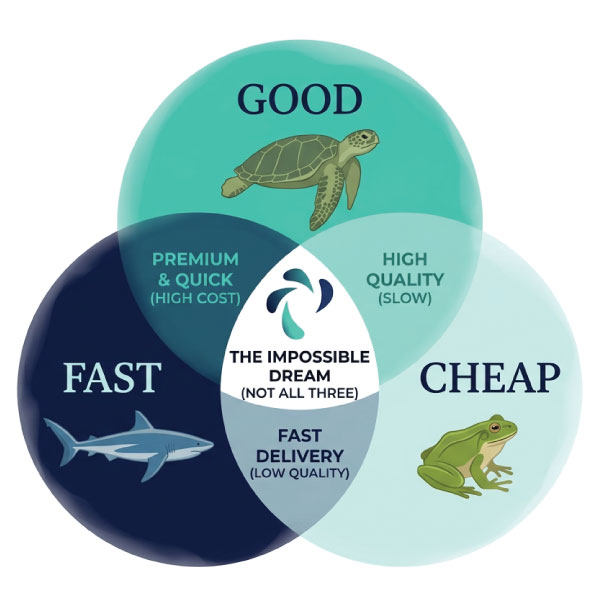 The Good–Cheap–Fast triangle applies as much to aquarium LSS projects as to any other engineering discipline: you can optimise for two, but rarely all three. Locking in your priorities during the concept phase saves enormous pain during procurement and construction.
Tendering: Getting the Right People Involved at the Right Time
Tendering for LSS work in zoos and aquariums is more nuanced than standard construction tendering. The specialised nature of the work means the pool of qualified contractors is limited, lead times on specialist equipment can stretch weeks or months, and a tender document that lacks technical clarity will result in wildly inconsistent and non-comparable quotes.
The right stakeholders should be engaged at each stage. Before going to tender, this means facility staff from management through to maintenance (who will directly look after the system daily), and experienced consultants who understand the technical specifications required. During tendering, involve the financial decision-makers and any technical experts who can evaluate the proposals meaningfully. During construction, keep facility staff involvement to a minimum — not because their input isn’t valuable, but because too many voices during construction creates confusion and scope creep.
A well-prepared tender document should define the scope of design responsibility (is the contractor designing the system, or delivering to a consultant’s design?), specify key equipment with acceptable alternates, outline performance criteria, include a variation policy, and detail handover and commissioning requirements.
Lessons from the Field: What Happens When Planning is Rushed
Across the aquarium and zoo sector, certain failure patterns emerge repeatedly when early planning is inadequate. Understanding these patterns is the first step to avoiding them.
Scope Creep and Budget Blowouts
When the scope of works isn’t clearly defined upfront, client variations accumulate rapidly. Without early planning to map the full scope, institutions routinely approve a headline figure only to discover that critical items — wastewater tanks, weatherproof structures, access platforms, electrical works — were not defined in the scope and were excluded, adding the risk of increased costs and delays.
Equipment Lead Times and Procurement Delays
Specialist aquarium equipment is not always available off-the-shelf in Australia. Protein skimmers, ozone generators, UV sterilisers, heat pumps rated for saltwater, and PLC control systems often need to be sourced from the USA or Europe or custom built, with lead times of four to eight weeks or more. Delays in deposit payments push these lead times out further.
For facilities planning to stock animals by a fixed date — whether for a new exhibit opening, a breeding programme milestone, or a conservation initiative — LSS procurement delays can cascade into missed stocking windows that are impossible to recover without significant additional cost. Planning early means procurement can begin as soon as contracts are signed, rather than waiting for the scope to be finalised.
Inadequate Site Preparation
LSS installation requires specific site conditions that are frequently overlooked until work is about to begin. Civil works site preparation may be required. Redundant pipes and brackets need to be cleared before new equipment can be positioned as well as access requirements may need to be considered.
The Role of Specialist Consultants and Contractors
One of the most valuable early planning decisions a zoo or aquarium can make is engaging specialist LSS consultants and contractors before the design is locked in — not after. The difference in outcomes between facilities that engage early and those that bring specialists in late is dramatic.
Pure Aquatics, based in NSW, is one of Australia’s specialist aquatic system design and installation companies with a high level of experience in zoo and public aquarium environments. Their team — led by Managing Director Lindsay Hopper and Public Aquarium LSS Specialist Bradley Dohnt — brings both the technical knowledge and practical site experience needed to navigate the unique challenges of these projects.
What does early engagement actually look like? It means involving specialists in the concept phase to review the biological requirements and translate them into engineering parameters. It means having contractors review draft tender documents to identify ambiguities before they go to market. It means conducting site inspections early enough that structural or spatial constraints can be designed around — not worked around under time pressure during installation.
Key Planning Priorities for Zoo and Aquarium LSS Projects
Based on real project experience across Australian facilities, the following priorities should be locked in during the early planning phase of any LSS upgrade:
Animal Needs First
Every LSS design decision should flow from the biological requirements of the animals it will support. Turnover rates, water temperature parameters, salinity, dissolved oxygen, ORP levels, biological load) must be defined before any equipment is selected. This isn’t just good animal husbandry — it’s the foundation of your engineering specification.
Redundancy Planning
What happens when a pump fails at 2am? What happens during a power outage? Redundancy decisions — whether to have backup pumps, dual filtration loops, UPS systems, or emergency alarm notifications — need to be made early, because they significantly affect both system design and cost. Retrofitting redundancy is always more expensive than designing it in from the start.
Simple vs. Automation
Highly automated systems with PLC controllers, HMI interfaces, remote monitoring, and SMS/email alarms offer significant operational advantages for large, complex exhibits. But they also require staff with the skills to operate and maintain them. Simpler, manually operated systems are more robust in facilities with smaller teams or limited technical capacity. Match the system to your team’s capability, not just the aspirations of the design brief.
Timeline Realism
One of the most common planning failures is underestimating the timeline. From concept to stocking, a significant LSS upgrade at a public zoo or aquarium typically takes six to eighteen months. Factoring in design approval, tender period, equipment procurement, site preparation, civil works, installation, commissioning, biological maturation, and staff training — each phase takes time, and none can be rushed without compromising safety or animal welfare.
True Budget — Not Just Equipment
The equipment cost is just one line item. A complete budget needs to include design and consulting fees, contractor installation costs electrical works, civil works, OH&S requirements, project management, spare parts, operator training, and a contingency allowance for variations.
Variation Policy
Agree in writing how variations will be managed before work begins. Who authorises variations? Within what timeframe? These conversations are much easier to have at the start of a project than when a contractor is standing on site and the clock is running.
Evaluating Success at Handover
Define what a successful handover looks like before the project starts. This will vary from project to project depending on the requirements of the client This could include:, commissioning of all equipment, operator training, and delivery of as-built documentation including O&M manuals, equipment schedules, and P&IDs Or may be a simple commissioning and testing of equipment before handover its important that all parties agree on what defines a complete handover.
Planning for Biological Maturation: The Phase Most Often Forgotten
Even when the physical installation goes perfectly to schedule, facilities are frequently caught off guard by the time required for biological filtration systems to mature. Nitrifying bacteria colonies — the foundation of biological filtration in any recirculating aquatic system — can take four to eight weeks or longer to establish on new filter media, depending on water temperature, seeding strategy, and ammonia loading.
Planning for maturation means building this period into the project timeline before stocking — not after. It means considering how the system will be cycled (such as ammonia dosing, bacteria supplements or potentially pre matured media), what monitoring will be in place during this period, and who is responsible for daily water quality testing. For facilities with fixed opening dates or media commitments around new exhibits, missing this planning step can mean launching an exhibit with a biologically immature filtration system — a situation that compromises animal welfare and requires rapid, expensive intervention.
Starting the Conversation Early: What to Do Right Now
If you’re responsible for a zoo or aquarium facility and you’re reading this because you know an LSS upgrade is coming — whether in six months or two years — the most valuable thing you can do right now is start the planning conversation.
That conversation should begin internally: What are the biological needs of your current and planned collections? What are the current failure modes in your existing systems? Where are the maintenance pinch points that cost your team the most time? What is your realistic capital budget and operational maintenance budget? And what is the minimum system performance standard below which you cannot safely operate?
Then bring in external expertise early. Engage an LSS consultant or specialist contractor to assess your existing systems and help you frame the scope of the upgrade. The cost of this early engagement is modest compared to the cost of correcting a poorly scoped project mid-construction.
Pure Aquatics offers design and consultation services specifically tailored to zoo and aquarium environments across Australia. Their team can help you move from initial concept through to a fully scoped, tendered, and installed system — with the experience to anticipate the complications that catch facilities off guard when planning is rushed.